Market intelligence · United States & Canada
Local competitor analysis, built from your rivals' worst reviews
It reads the 1–3 star Google reviews of the top 25 businesses in your niche, and gives you a game plan on how to outrank them.
NO MODELED ESTIMATES · NO FABRICATED QUOTES · COMPETITOR NAMES NEVER SHARED
Prices in USD. Start with one market or watch several. Reading the full sample is always free.
Single report
One niche and city. Valid 90 days. The whole brief, no subscription.
- +1 market report
- +All 8 sections
- +PDF export
- +90-day access
Operator
Most pickedUp to 3 markets, refreshed every 30 days so you watch the trends move.
- +3 markets
- +Auto-refresh monthly
- +Trend shift alerts
- +PDF export
Agency
Up to 15 markets, refreshed twice a month, white-label PDF for clients.
- +15 markets
- +Refresh every 14 days
- +White-label export
- +Priority pipeline
NO CARD REQUIRED TO GENERATE · WE SAVE YOUR PLAN WITH THE REPORT · CHECKOUT ISN'T LIVE YET
See inside a real report
No mockups. Real screens from a live GroundTruth report on the Toronto movers market, the same one you can open in full.
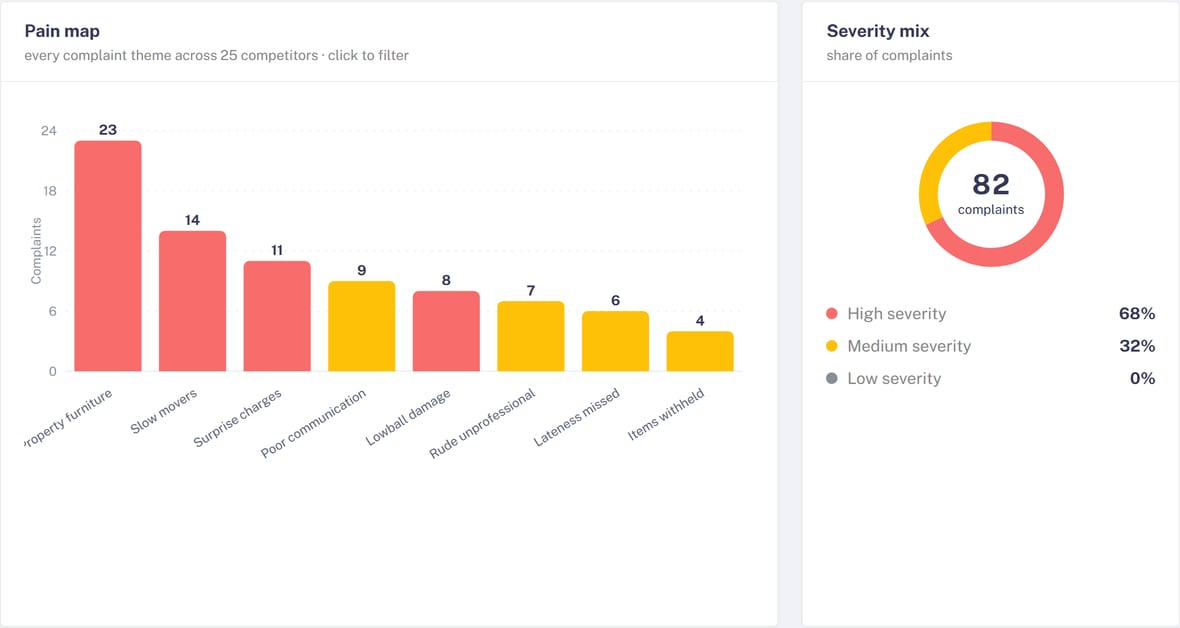
The pain map
Every complaint the market repeats, ranked and severity-coded, each bar opening to the real verbatim reviews behind it. The tallest one is your opening.
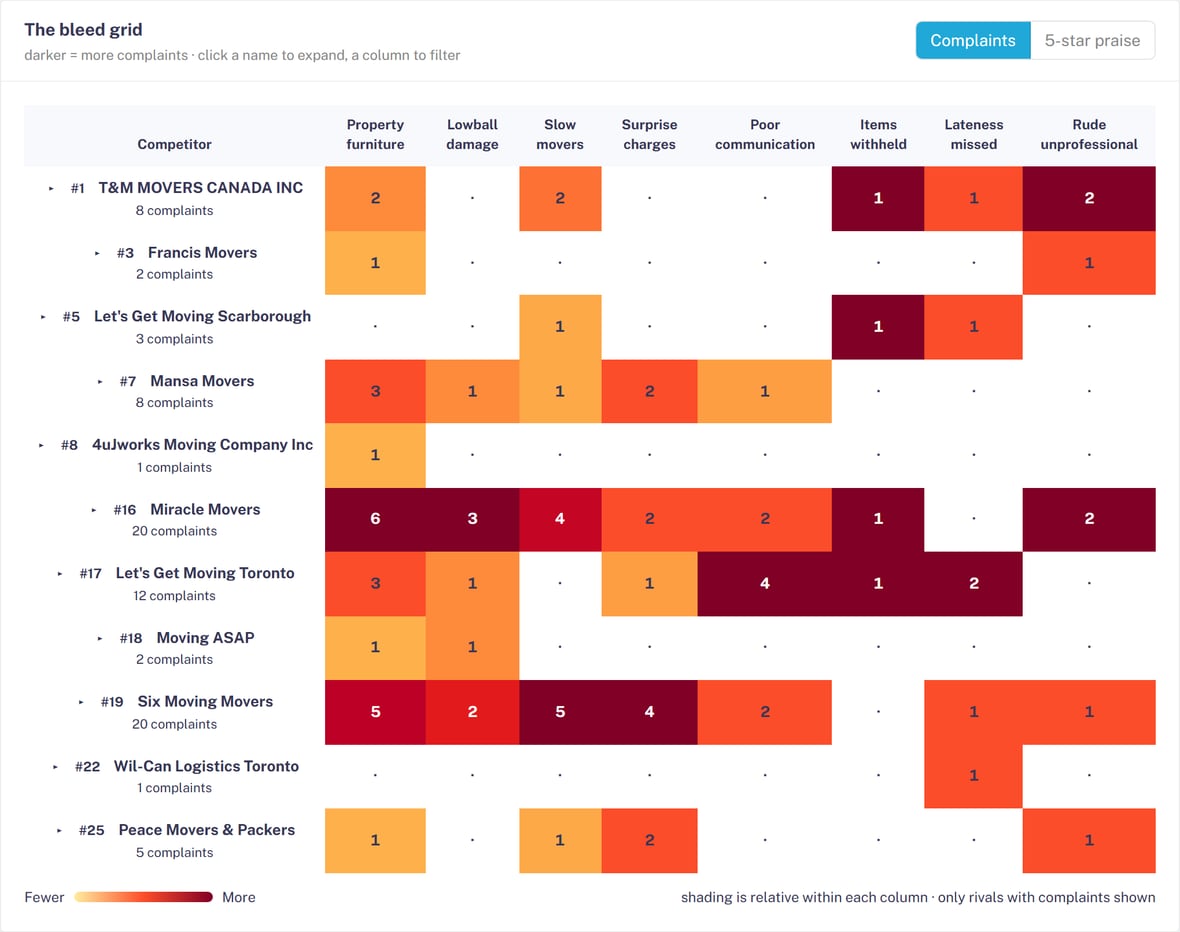
The weakness grid
Every rival scored against every complaint theme. The darker the cell, the harder that business gets dragged there. Read down a column to find who is weakest on the pain you can own.
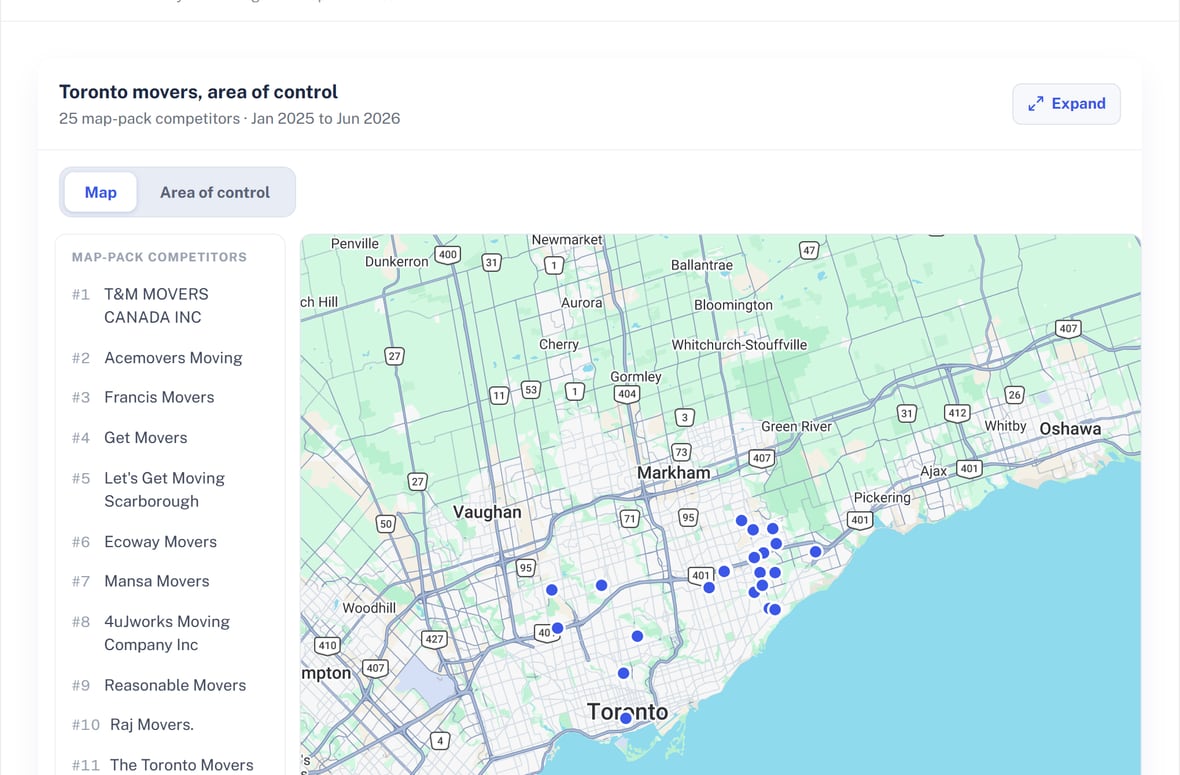
Area of control
Each competitor's real reach across the metro, measured from Google's local pack. See exactly where a rival holds the top spots and where the map is wide open.
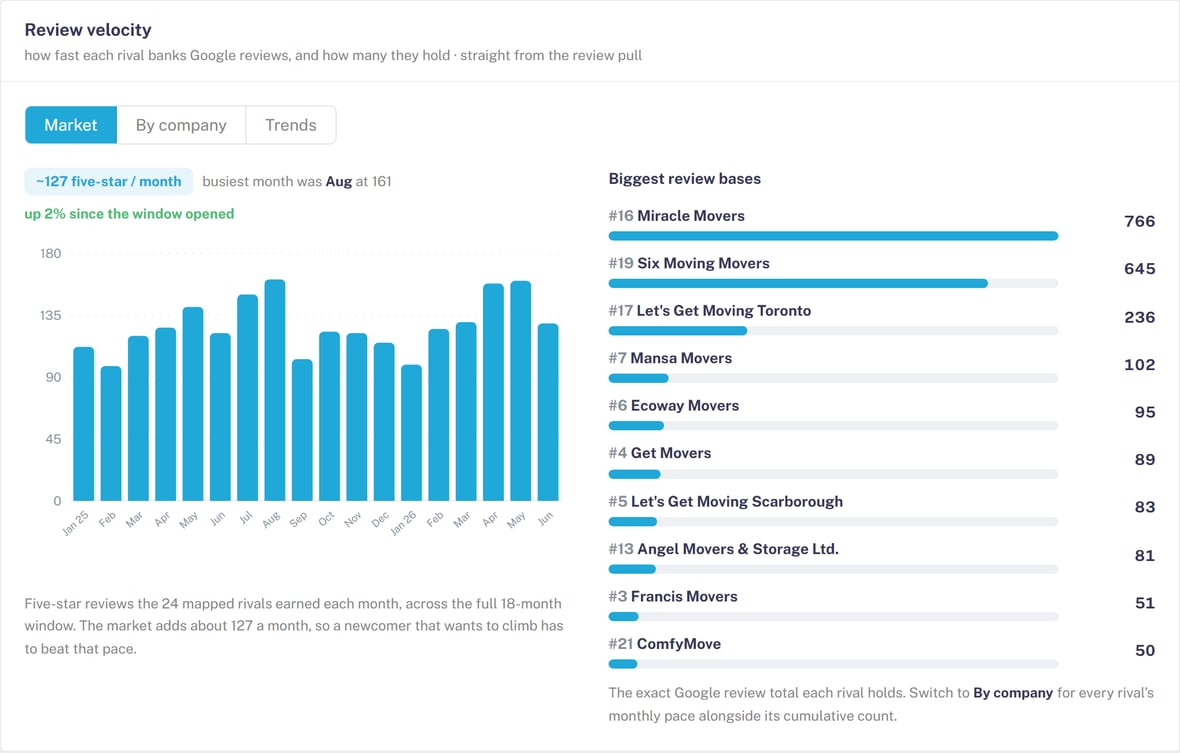
Review velocity
How fast each rival banks Google reviews month over month, and who holds the biggest base. Spot who has momentum and who has gone quiet.
Swipe through all four
What is GroundTruth?
GroundTruth is a market intelligence tool for local service businesses. It aggregates the public negative reviews of the top 25 competitors in a given niche and city, cross-references local Reddit discussion, and produces a consulting-grade brief on what the market complains about, where competitors are weak, and what nobody is offering. It serves trades, clinics, salons, and professional services across the United States and Canada, and every output is grounded in real, citable public data, never modeled estimates.
What is in a report?
A GroundTruth report is eight sections: an executive summary, a ranked pain map with verbatim review evidence, a competitor weakness matrix, the voice of the market from Reddit, the underserved gaps, three differentiation angles in your own voice, a set of pain-point SEO targets with page outlines, and a methodology footer. You do not read it like a blog post. You run it: build the pages, ship the positioning, calibrate the pitch.
How it works
Four moves, about ten minutes of machine time. You answer a few questions, then read the brief.
- STEP 1 OF 4
We find the top 25
Enter your niche and city. GroundTruth pulls the top 25 businesses in the Google map pack, the ones you actually compete with for the same searches.
- STEP 2 OF 4
We read their 1–3 star reviews
Every negative review from the last 12 months, across all 25. Hundreds of them. The complaints that repeat are the market telling you where it hurts.
- STEP 3 OF 4
We listen to local Reddit
What your city says when no business is watching. It surfaces pains people never bother to leave a star rating about, the under-the-radar stuff.
- STEP 4 OF 4
You get the brief
A plain-English intelligence report: the ranked complaints, a competitor weakness grid, the gaps nobody fills, three ways to stand apart, and the pages to build.
Questions, answered straight
Where does the data come from?
Public Google Maps reviews from the top 25 businesses ranked for your niche and city, plus Reddit posts and comments from your local and regional subreddits. Nothing modeled, nothing invented. Every quote in the report is a real review, with its date and a link back to the source, and the business name redacted.
Is this legal? Are you naming competitors?
The report is built only from public data, and it never names a competitor. Rivals are shown as Competitor A through Y. Real names are encrypted and only ever visible to you, never in a shared or exported report, never sent to the AI that writes the synthesis. Every report ships with a methodology footer that states exactly how it was built. That footer is your paper trail if you use the insights in your own marketing.
How is this different from Birdeye or Yext?
Those tools manage your own reviews. GroundTruth reads the whole market's reviews, your 25 competitors included, and tells you what customers are mad about across all of them. It is not reputation management. It is market intelligence: where the demand is going unmet and how to position against it.
How long does a report take?
Five to ten minutes. We scrape the competitors, read their negative reviews, pull the Reddit signal, and write the brief. You get a progress bar while it runs and an email when it lands.
What do I actually do with it?
Write the pages in section G to catch customers mid-switch. Put the section F positioning lines on your site, your truck, your sales script. Calibrate your ads and your voice agent against the complaints that repeat. You end up the one operator in town who openly solves what everyone else gets dragged for.